Read the whole subcontract package
Use the bid scope, specifications, insurance exhibit, prime contract provisions incorporated by reference, rental agreements, and change-order terms. Identify the contracting legal entities and project location. Highlight any requirements that apply during mobilization, temporary storage, installation and completed work. Separate insurance requirements from indemnity, defense, warranties, expense reimbursement, damaged owner material, and delay provisions. Ask counsel to resolve legal duties and enforceability in the governing jurisdiction.
Look for the decision points where one entity could reasonably assume the other has agreed to provide something. The GC may plan a supplier's delivery, the crane company may dispatch an operated unit, and another subcontractor may provide the rigging crew. Decide who supplies personnel, equipment and transportation before using the phrases full service, operator included, or owner provided. Capture the exact items included in each company's price and compare them with what the signed documents say. Pay attention to short forms attached to dispatch tickets when their terms differ from the subcontract.
Document who controls the site interface
Identify the controlling entity where applicable and the teams responsible for site access, ground readiness, engineering inputs, traffic coordination, nominations of setup and work areas, and management of work changes. For covered construction crane operations, federal OSHA's 29 CFR 1926.1400 defines the scope of Subpart CC. 29 CFR 1926.1402 addresses ground conditions. It assigns specific responsibilities to the controlling entity when one exists, including arrangements for necessary ground preparations and communicating certain known underground hazards. Check the complete rule, its provisions when there is no controlling entity, and any applicable state requirements.
The insurance file should record which entity holds relevant site information and who communicates revisions. Heavy civil work may involve a changed access point, a bridge deck or structure, utility records, a revised closure, a new staging area, or an occupied adjacent site. Get the current site plan and the relevant issue logs from the qualified team. Keep engineering, site approval, and equipment decisions with those qualified to make them. The Federal Highway Administration's Work Zone Mobility and Safety program offers project context. The controlling traffic plan, approvals and responsibilities come from applicable authorities and project documents.
Follow an illustrative precast delivery
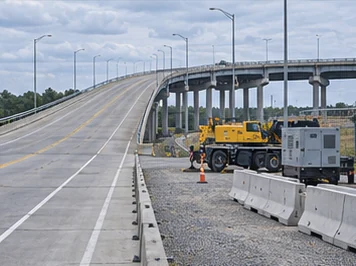
Assume a highway contractor arranges delivery of a precast element to a bridge replacement project. The freight carrier brings the element to a designated handoff point, the crane subcontractor provides an operator and unit, and the erection crew accepts the piece after placement. A traffic window changes, and the parties agree that the load will wait on the trailer until the next approved window.
Record the load owner's name, the agreed values, and the carrier's delivery and unloading obligations. Identify where possession and responsibility are expected to transfer, and compare that expectation with the actual purchase, transport, lifting and erection agreements. If the new waiting period changes storage or custody, collect the agreement and documents that confirm the revised allocation. A claim during the wait can raise different questions than damage while lifting, setting or attaching the component.
The same event can produce different asserted losses. The load may be damaged, the crane may need repair, a nearby public or third-party asset may be damaged, and the project may incur a second closure cost. Keep separate records for each exposure and route the policy analysis to the applicable agreements and programs. Ask how the affected property is described, where the event must occur, when the relevant operation begins and ends, and whether the financial consequence meets an insuring agreement.
Review policy form interfaces and project conditions
Discuss riggers liability for the property being handled, contractors equipment and any rented unit, general liability for bodily injury or damage to other property, workers' compensation and employers liability for relevant employers, and auto for mobilization and transportation functions. For installation or transit-related coverage, identify whether the terms include the component and the party with an insured interest in it. Confirm valuation, exclusions, limits, and deductibles against the project values and responsibilities.
When the insurance exhibit requests additional insured status, primary and noncontributory wording, waiver of subrogation or limits by line, ask for the actual endorsements or corresponding policy text. Identify the entities and work covered, and check ongoing and completed operations separately where the agreement requests both. If there is an owner- or contractor-controlled program, verify which trades, payroll, work locations and lines are enrolled. Make a separate list of excluded operations or site activities that need to be addressed in a contractor's own program. An excess layer should be compared with the underlying policy and with any project-specific coverage structure. Naming an excess limit on a certificate leaves those form questions open.
Account for changes after award
An insurer may have reviewed one set of operations, equipment and locations when setting its terms. Flag substitutions, adding a rented unit, delayed work, storage changes, an expanded lift scope, working beside a rail line or over water, or accepting a previously excluded task. Put the relevant decision and responsible contact in the change log. Give risk managers the revised expectation, effective date and reason for the change. When an operator engagement changes, identify the employer and verification owner. Federal OSHA's 29 CFR 1926.1427 addresses training, certification or licensing, and evaluation for covered operators with specified exceptions.
For broader civil-project insurance topics, see Montridge's Heavy Civil and Highway Contractors Insurance guide. To prepare for the Crane & Rigging Insurance Review, bring the relevant contract package, equipment schedules, load values and work boundaries, rental terms, project insurance evidence, escalation contacts, and the documents proposed as proof of policy conditions. The Lift Contract and Insurance Review Checklist can help organize what each decision-maker needs to confirm.
Sources reviewed November 28, 2026. Federal construction safety references are identified above. Confirm state coverage, project requirements, and contractual obligations with the applicable parties.